OFF THE RECORD #128

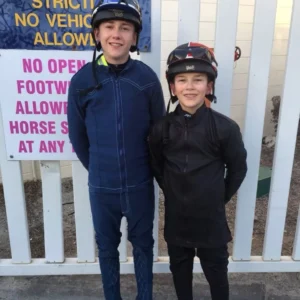
Brett Smith: Back On The Record
Former jockey Brett Smith, a prolific Grade 1 winner in his heyday, has kept a low profile since hanging up his saddle in 2010. Life after racing brought more than its share of challenges, including a neck injury that ended his days on the golf course, a few personal setbacks and the disruption of the Covid-19 years, all of which gradually drew him away from public view.
Smith emerged from the shadows after reading last week’s Off The Record profile on the forgotten champion, Home Guard.
“It stirred up a lot of memories,” he said. “I felt it was time to get back in touch.”
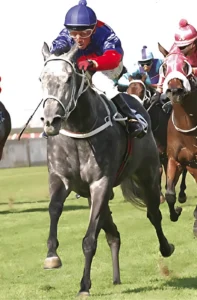
Smith, who enjoyed spells as stable jockey to several of South Africa’s leading trainers, including Geoff Woodruff and Sean Tarry, partnered a host of top-class performers during his career, among them Eventuail, Badger’s Drift, Pacific Blue, Mythical Flight and National Colour. He said the story of Home Guard transported him back to his apprentice days.
“I started as an apprentice in 1979, just after the Home Guard era, but I remember him well. He was revered by the racing public at a time when people truly adored their racehorses, and I wish we could do more to foster that same love for the horse among today’s youth. Once horses get into your blood, they become a way of life forever.”
Smith said he was encouraged by the willingness of racing’s operators in recent years to think outside the box with their marketing and promotional campaigns in an effort to attract a broader audience.
“I was watching the build-up to the Hollywoodbets Durban July, the publicity around the women jockeys and, just this week, a few editorials highlighting the challenges riders face behind the scenes. They all go a long way towards educating the public.”
“It’s strange, but jockeys have never really been regarded as athletes, whereas the reality is quite the opposite. The fitness levels required are beyond what most professional athletes could or would ever attain. Competing at the highest level of this sport is mentally and physically demanding to an extraordinary degree.
“If we’re talking about gender, and this is what I’ve observed over 45 years in racing, talent has never been the issue. The biggest challenge has always been maintaining the dedication to fitness needed for a long and successful career. Someone like the American Julie Krone, who rode more than 3,700 winners, was one of the first women to master both, and many female riders have followed the standards she set.
“There have been some remarkable achievements, with Michelle Payne winning the Melbourne Cup and Jamie Melham (née Kah) rising to the top in Australia. In Britain, Hollie Doyle has reached a level that shows what can be achieved through exceptional dedication to fitness and professionalism.
“Our own Rachel Venniker is a consummate professional with enormous potential, while Mickaëlle Michel has impressed me greatly in her short time in South Africa. She has style, poise, excellent pace judgement and a calm temperament in a race, allowing her to get the best out of her mounts. I believe she has all the attributes to achieve even greater success.”
Smith was particularly impressed by Hollywoodbets Durban July winner Note To Self.
“Here was a three-year-old by Futura, stoutly bred, who first emerged as a July contender when he won a handicap in January. As promising as he looked, there were experts who felt he lacked the speed to win at Grade 1 level.
“Note To Self appeared one-paced in the Daily News and some were quick to write him off, but this was a masterful training performance by Justin Snaith and his team. They knew exactly what they had and timed his preparation to perfection. Just look how he turned it on when it mattered most. He came from near the back and mowed them all down with a tremendous turn of foot.”
Smith said that before the advent of live television, race replays, track reports and stable previews, racing fans had to rely almost entirely on the naked eye to identify and follow emerging stars. Many did just that. The champions of yesteryear attracted legions of devoted followers who flocked to the racecourse to watch them in action.
Today, with more racing information available than ever before, Smith believes enthusiasts should make full use of the resources at their disposal.
“Note To Self is a perfect example of a horse who developed beautifully from his debut a year ago. There were critics who said he’d be too slow and would never be suited to Hollywoodbets Greyville. But punters who studied his race replays, watched his gallops and listened to the pre-race interviews would have recognised his progress. They were the ones who cashed in.”
One piece of advice Smith offers serious punters is to pay close attention to the pre-race canterdowns, especially in juvenile races where young horses are stepping onto a racetrack for the first time.
“Getting to know the physical attributes of a horse is a valuable tool when assessing its progress. If you watch them closely from one run to the next, you begin to recognise when they’re looking their best. More often than not, that’s when they produce their best performances.
“The opposite is also true. Once you get to know a horse, you start noticing the little things – a dull coat, a tendency to sweat up, or a stride that isn’t as fluent as it should be. It might sound like the preserve of experts, but developing a trained eye is something anyone can achieve with regular practice.
“The flashy chestnuts and the rich bays or black horses are often the first to catch the eye, but keep an eye on the unassuming youngsters that start off looking dull. They’re often the ones who turn the corner over time.”
Smith recalled a few tales from the early 1980s, the first involving a horse called Woodcutter, by Taxiarchos.
“I was apprenticed to James Maree on his farm at Eikenhof, where he was building his own stable complex and training tracks. James had plenty of horses in training, but he was still developing the property, so things were a bit rough around the edges.
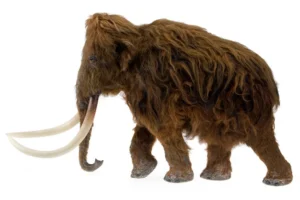
“In that country environment, far removed from the polished training centres elsewhere, there emerged a big, hairy creature we nicknamed ‘The Woolly Mammoth’. He was heavy, slow in his sand work, plodded along and battled to keep up with the others. We loved him because he had such a wonderful nature.
“James started him in a Maiden Plate over 1000m and gave me the ride. The Woolly Mammoth plugged on for third in a small field, beaten about 15 lengths. We thought, ‘Well, that’s not bad. He’s earned us a stake cheque, which is more than we expected.’
“After that I was busy riding other horses in their work and didn’t pay much attention to Woodcutter for a few weeks. Then, one morning, he caught my eye. He’d shed his woolly coat, looked lean and mean, and James entered him for another maiden sprint with Robbie Sham in the saddle.
“Woodcutter sprinted away from them that day, won as he liked, and then reeled off another six victories on the trot, including the Chairman’s Handicap at Turffontein. The Woolly Mammoth had developed into a sleek racing machine.”
Another example of an ugly duckling turning into a swan came during Smith’s time with Robbie Sage in the mid-1980s.
“Robbie had a few top-class runners, including the imported sprinter Only A Pound (Sharpen Up), who had already won several sprint handicaps. He was lightning quick and destined for a career at stud.
“Robbie also stabled a big, clumsy, unraced colt called Welcome Guest (Gatecrasher), who really battled in his sand work. He was painfully slow and gave little indication that he had much of a future.
“One morning, Welcome Guest was due for a grass gallop and Robbie gave me the ride, saying, ‘Just let him stride along, he’s very slow.’ As it happened, we went to the track alongside Raymond Rhodes on Only A Pound, simply to give him some company.
“To our astonishment, Welcome Guest cruised alongside Only A Pound, then went straight past him and left him standing. We just looked at each other in disbelief. From that day on, Welcome Guest worked brilliantly on the grass, and he reproduced it on the racetrack, winning nine races, including the Grade 1 Computaform Sprint.”
Another horse Smith remembers fondly is St John Gray’s Biarritz (Count Du Bois), who raced between 2006 and 2010.
“Biarritz absolutely hated working in the mornings. It could take him 20 minutes or more just to walk from his stable to the track and, when he got there, he’d dig his heels in and refuse to gallop. If we were lucky, we’d persuade him to canter.
“St John always said, ‘Just leave him, that’s his nature.’ To this day I don’t know how that horse ever got fit, but come race day he was a completely different animal. He’d prick his ears, switch on and run them ragged.
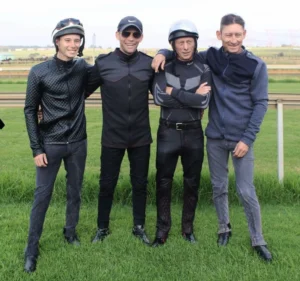
“I won the Grade 2 Gauteng Guineas on him, beating Piere Strydom on Ravishing. Biarritz was top class and one of the nicest horses I ever rode.”
Smith’s passion for racing never faded after retirement. Instead, it found a different outlet through G1 Racegear, the boutique business he established to supply jockeys, work riders and equestrian enthusiasts with quality riding gear and equipment. He is now developing a new range of technically advanced riding apparel and boots incorporating the latest innovations in performance and comfort.
The venture has occupied much of his life over the past 16 years, keeping him connected to the sport while providing purpose through some difficult periods.
If his recollections are anything to go by, the sharp eye that served Brett Smith so well in the saddle remains as keen as ever.