
OFF THE RECORD #126
Cracking the Durban July Code
Every year, as the Hollywoodbets Durban July approaches, thousands of racing enthusiasts dust off their theories, trends and trusted formulas in an attempt to identify the winner. Yet despite all the study and speculation, solving the July puzzle remains as difficult today as it was generations ago.
If anything, the challenge has become even greater under the race’s revised handicap conditions, which were introduced to create a broader weight spread and a more competitive contest. They have also made it increasingly difficult to separate the leading contenders.
There remains a bewildering array of variables to consider, but readers are encouraged to spend a little time revisiting past Durban July replays on Youtube, most of which can be found with a quick online search. Apart from stirring fond memories, they reveal several intriguing patterns and observations that may still hold relevance today.
The first striking observation is that, while jockeys continue to regard the draw as a crucial factor, the Durban July can be won from virtually any barrier position. Indeed, history suggests that drawing pole position has been more of a disadvantage than an advantage. Also, runners that come from well off the pace are not out of it.
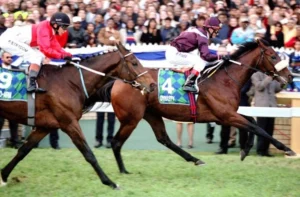
Just in recent years, the race was won from the widest of draws by The Conglomerate (2016), Belgarion (2020) and Kommetdieding (2021), but there are more examples down the years, including Flaming Rock (1991) and Dynasty, perhaps the most famous widely-drawn July winner in 2003.
The replay of Dynasty’s victory is particularly compelling. It shows the talented three-year-old – who would later become a great sire and sire of sires – racing as wide as six deep in the early stages and pulling, before securing some cover down the back straight.
It also highlights a pattern evident in a number of July replays. The winning jockey often makes a decisive move before the home turn, typically between the 650m and 500m marks, improving into a striking position before asking for the ultimate effort in the straight. Robbie Fradd executed the manoeuvre to perfection aboard Dynasty, and many July-winning riders have followed a similar script.
Fradd had his sights on Piere Strydom, riding the free-striding front-runner, Yard-Arm, and said: “I finally had Dynasty in my hands and I was happy where I was. He was going well. I looked across at Yard-Arm and Piere and they were going good as well. I said to myself, I don’t want to be more than two lengths behind him when we turn for home.”

Speaking to Off The Record this week, Strydom said: “Jockeys do try to make their move before the bend because the Hollywoodbets Greyville straight is so short, but you still need a decent horse underneath you. What invariably happens in the July is that riders go hell for leather to secure a good position over the first 600 metres, and half the field have nothing left when they approach the bend. They seem to fall into that trap too often.”
Strydom’s explanation points to the importance of jockeyship and sound judgement of pace. Significantly, he won his four Durban Julys from inside, middle and wide draws, employing different tactics in each case – setting the pace on one occasion (London News, 1996) and coming from near or off the pace on others (Trademark in 1991, Pomodoro in 2012 and The Conglomerate in 2016).
Trademark, in fact, set the course record for 2200 metres when he won the race in 131.76 seconds, a time that still stands head and shoulders above the rest. Yet Strydom cannot fully explain it.
“I remember the pace being normal that day; it wasn’t exceptionally quick,” he recalled. “I was sitting in midfield early in the race and Trademark was travelling strongly on the bit. Normally, when the pace is fast up front, the horses in midfield are off the bit trying to keep up, but Trademark wasn’t. The track was very dry that day, which may have played a role, or it could simply have been an error in the timing.”
There have been some bizarre officials’ errors around this race (arguably the demotion of 2014 winner Wylie Hall to second place was the biggest glaring travesty of them all), but it is unlikely that the clock was wrong when Trademark won. Strydom’s four July winners won in an average time of 132.9s, which is 1.63 seconds faster than the average Durban July winning time (134.53s) over the past 50 years.
That jockeyship plays a crucial role in winning the Durban July is hardly a groundbreaking conclusion, but it is a useful reminder that punters should look beyond the horses alone and take careful note of which riders arrive at Greyville in peak form.
Having won the race four times and ridden in many more, Strydom’s views carry considerable weight. His assessment of this year’s renewal is that a well-handicapped older horse appears the most likely winner, particularly under the race’s revised handicap structure.
One should perhaps combine that view with the earlier observation that many Durban July winners possess the pace and stamina to make a bold move just before the bend and then keep finding to the line.
Strydom liked Field Marshal as his best roughie before the final field was announced (and holds the view that he will go close in the July Consolation, the Magical Zulu Kingdom 2200). With Field Marshal out of the July itself, he now believes that the controversial Regulation fits his best profile of a handily weighted older horse, though his current market price of 7-1 is perhaps not the value one would have expected.
It could also be, however, that we’re all looking for a ‘spook’ when this year’s July winner is obvious: The ante-post favourite, Star Major!
Computaform summed it up well in their Pick 6 preview: “At first glance, this year’s renewal of the great race appears a fiendishly difficult puzzle. The revised handicap conditions have created a broad weight spread, several runners bring legitimate winning claims and there is no shortage of attractive outsiders capable of springing a surprise. Yet punters should be careful not to become overly fixated on the 57kg allotted to this season’s classic ace, Star Major.
“While it is a substantial burden for a three-year-old, he still receives 5kg from top weight Legal Counsel, as he would have done under the previous handicap conditions. More importantly, the manner of his victory in the Grade 1 Daily News 2000 stamped him as a horse of exceptional ability. His devastating turn of foot settled the race in a matter of strides and suggested that he may only now be approaching his peak.
“Star Major meets Classic-winning filly Wish List on the same terms as when she defeated him in the Grade 1 Lucky Fish Cape Derby six months ago. However, he is a stronger and more mature horse now, appears to have improved considerably since then and clearly enjoys a productive partnership with Mickaëlle Michel.
“It is also worth noting that Star Major’s Daily News winning time was significantly faster than that recorded by Wish List in the Woolavington 2000 over the same distance on the same afternoon.”
So, who fits your own Hollywoodbets Durban July profile best?
The chips are down!