
OFF THE RECORD #122
Inside Mano Pandaram’s Unconventional Journey
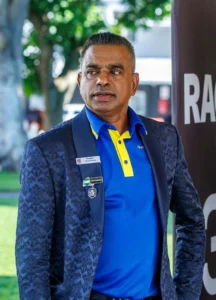
In his early thirties, standing on the edge of the parade ring at Hollywoodbets Greyville, Mano Pandaram watched the colour, the muscled thoroughbreds, the theatre of it all, and made himself a promise: “I want to be inside the ring. I’m going to be a part of this one day.”
At the time he was a motor mechanic – like his father – and earning just enough to buy entrance tickets to Durban’s big race days, where he would spend hours punting alongside a racing-mad circle of family and friends.
It would take more than two decades before his vision became reality. Now licensed as a fully-fledged trainer at 56, Mano has arrived in the game carrying with him not only ambition, but a reputation as something of a difficult character, and a determination to do things differently.
Not everyone in racing is easy to like, but not everyone needs to be. Mano has learned plenty on his unconventional journey into the training ranks – chief among them the value of shutting out the noise, trusting his instincts and focusing on where he wants to go.
That said, he’s not here to blend into the background. He wants to achieve, and says his strong-willed demeanour is rooted in his upbringing in Verulam, north of Durban. “Who you are comes from what you were taught. I’m big on discipline in my business, with my kids, and with my horses, and I like to do things my way.”
He joked about the environment of his youth: “When they moved King Shaka International Airport to the north of Durban, they finally put Verulam and Tongaat on the map. We were obscure, but people know about us today!”
Mano is a Tamil-speaking Hindu with a strong connection to Indian culture and tradition. He reflects on the post-1994 shift: “When equal opportunities opened up, many Indian businessmen rose to the top, and a fair number of them found their way into horses and horseracing.
“That was always going to happen, because Indian people love horseracing – the glitz, the glamour, and the promise of a better life. I’ll tell you this: Indians are good at mathematics. They see a challenge in cracking codes. When opportunities are limited, people look for ways to make money, and horseracing becomes a kind of code to a better life. Every race is like a mathematical problem waiting to be solved. And every time you crack it, money comes to you.
“Indian people have become very important players in the game, and I’d venture to say it is their passion and participation that created the great atmosphere at Hollywoodbets Greyville we see today. They are the lifeblood of the sport in KwaZulu-Natal, and because I interact closely with these communities, I know how many more are eager to get involved in racehorse ownership, even at a small shareholding level. That’s encouraging.”
Mano’s own business acumen had, by 2014, elevated him to a position where he was able to strike out on his own. Having worked his way through the ranks of the motor industry – holding various management positions in the technical, sales and fleet management divisions at Toyota SA and Nissan SA – he had acquired the financial standing that enabled him to pursue racehorse ownership in the years that followed.
Mano is complimentary and grateful to all the trainers that he has spent time with since, and spoke about their good relationships. He also praised the people who contributed to his growth in his formative years as a horseman: jockeys, apprentice jockeys and agents, in particular Monty Marimuthoo.
First, he approached trainer Alec Laird, and accompanied him to the CTS Cape Premier Yearling Sale in 2019.
He recalled: “I had no idea about physical conformation, what a good yearling was supposed to look like. Alec had identified a few horses for us to buy, but he wasn’t particularly keen on my choice, a colt by Count Du Bois called Countfonic Legacy. But the horse stayed on my mind, so I applied for a buyer’s card myself and bought him against Alec’s wishes.
“I started bidding by making eye contact with the bidspotter and winking at him so Alec wouldn’t realise what I was doing,” he laughed. “Alec thought the bids were coming from a buyer sitting behind us and said, ‘Look, someone likes your horse.’ But when they arrived with the purchase slip, Alec realised what had happened and was not impressed at all.
“We bought two colts that year from the Cape Premier Sales and so the journey began. Countfonic Legacy and Time Spirit was all I could think about every day. I couldn’t wait to see them run in a race.”
Mano’s first purchase wasted little time rewarding his faith by winning on debut on 21 February 2021. “My first runner, Countfonic Legacy, was a winner and I was proud as punch. I celebrated and watched the replay over 100 times and it remains my proudest and happiest moment in racing. Time Spirit also won twice.”
His stint with Alec Laird was an eye-opener, and his subsequent move to the Vaal with Ashley Fortune was special while enjoying a promising filly, Juliet Tango (Rafeef) that Ashley spotted for him. (She won for the fourth time at the Vaal this week).
He also had a spell with Michael and Adam Azzie which he describes as an experience he will never forget. “Their immaculate attention to detail when turning their horses out on race day is something to witness. Through my association with Mike and Adam I eventually added River Romeo to my string.
“I realised that the old-school horsemen are entrenched in their methodologies and will always do things their way. They are successful in their own right for that reason. But I was seeking something different, maybe my own personal touch giving birth to my own stable managed by a personal trainer.”
Following consultations with the NHA, Mano employed Lunga Gila as his private trainer and registered himself as a stable employee so that he could, in due course, qualify for his own trainer’s licence.
However, this relationship eventually went pear-shaped.
“To begin with, Lunga and I simply didn’t see eye to eye. It was a personal thing, it happens between individuals all the time, and things just didn’t work out. At the same time, I was experimenting with stem cell therapy as a regenerative treatment for injured horses, which was perfectly legal, but rumours started circulating that I was ‘doping’ horses.”
Before long, the rift between Mano and Lunga spilled into the media – a period during which Mano feels he was unfairly treated and denied the opportunity to properly explain his side of the story. Lunga departed, and the NHA launched an investigation.
“I opened my doors to the NHA and invited them to inspect every corner of my racing operation. As expected, I was cleared of any wrongdoing. I did absolutely nothing wrong, in fact will never do anything to hurt a horse or gain an unfair advantage. The NHA officials were actually surprised at how preposterous some of the claims against me were.”
The quickest route to establishing his own training operation was to register as an assistant trainer, and Paul Matchett offered Mano the opportunity to join his stable and learn the ropes. “I was given the freedom to do my own thing. During my time with Paul, I educated myself through reading and video tutorials, and completed the prescribed term as an assistant trainer.”
Mano was granted his owner-trainer’s licence and saddled his first runner at the start of the current season on 1 August 2025. Since then, he has sent out 14 winners at a respectable 12% strike rate, highlighted by his first double at Hollywoodbets Greyville on Guineas Day, 2 May.
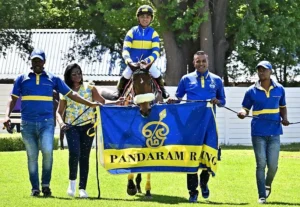
His winners include top-level performers Thunee Playa and his personal favourite, Indian Ocean – a talented six-year-old mare he believes is capable of winning again – as well as the likes of Porridge Boy, Vannakam, Thoonsil and Kudikaran. Among his younger horses, Mano believes the Malmoos colt, Kovil, is a runner with a bright future.
Many of his runners carry Indian names, and Mano explained: “I’m very close to my culture. I see myself as a spiritual person. I enjoy Indian music and watch a lot of Indian movies. Sometimes I pick up an interesting name in a song or a film.”
Mano was recently granted an open licence, allowing him to train for the wider public, and he is keen to offer owners a more involved experience. He is now also assisted by S’Bu Bhantiwe, a right-hand man he describes as ‘his eyes and ears’.
“I’d like to give supporting patrons the kind of experience I always felt owners should have – closer involvement. I want them to feel the burn, experience the passion. That doesn’t mean dictating training programmes, simply being more connected to their horses’ careers.
“If an owner spends, say, R100,000 on a yearling and another R100,000 on training fees before the horse even reaches the track, he or she should have some input into career planning. I don’t think that’s asking too much. The relationship between trainers and owners has changed over the last 20 years. In my view, trainers who don’t bring their owners closer to the coalface are doing themselves a disservice.”
Does he still have things to learn from the country’s leading stables?
“Absolutely,” says Mano. “There’s a saying that you never stop learning in this game, and it’s entirely true. You learn every day. But I also believe the actual training side is very personal. It differs from horseman to horseman and should always remain open to experimentation.
“I’m still at the beginning of my journey. I’m a willing student and grateful for what I’ve learnt so far. The recipe for success in training isn’t a secret. You need a good horse to start with. Then you need to feed and condition it properly, and exercise it correctly. Lastly – and importantly – you need to place it in the right races.
“Where I feel I can still gain from the methods of top trainers is in the placing of runners. The big names – Justin Snaith, Mike de Kock, Sean Tarry, Alec Laird and others – are masters at mapping out individual career paths. That takes experience and a careful understanding of the process.”
He concluded: “Racing can make you restless, even depressed, and the only cure is to saddle your next winner. When I wake up in the morning, I know that every step I take – all the love and effort – goes into the process of reaching my next success.
“In the end, it’s all for those two or three minutes of intense pleasure when a plan comes together. That, I think, is what keeps most trainers going.”