
OFF THE RECORD #141
Racing History Is Not AI’s Playground
There is an excellent documentary on Netflix about the so-called ‘Unabomber’, Theodore Kaczynski, a mathematics professor who terrorised Americans between 1978 and 1995 with a campaign of mail bombs.
Kaczynski vehemently opposed modern technology, arguing that it had become a totalitarian force that threatened human freedom and forced people to adapt to machines. His campaign killed three people and injured many others. He was eventually arrested and spent the rest of his life in prison before dying in his cell in 2023.
Kaczynski’s violent methods were indefensible, but his broader concerns about society’s growing dependence on technology have become increasingly relevant in the age of artificial intelligence.
Journalism is one of the professions now confronting those questions, as AI changes the way stories are researched, written and presented.
It is fair to say that anyone who intends to dedicate a lifetime to opposing AI, like Ted the terrorist opposed the growth of technology, will eventually find themselves in a virtual prison of the mind, fighting a battle that cannot be won.
AI has also arrived in the specialised world of horseracing journalism. It was never something we were going to escape. The challenge, it appears, is to integrate its benefits without losing the authenticity of racing’s long and storied history.
The various social media platforms have seen a mushrooming of AI-driven racing sites offering everything from tipping and opinion pieces to historic racing stories and personality profiles – most of them seemingly designed to bait readers for clicks.
There are well-established South African racing forums, including ‘Love Racing’, which has built a sizeable organic following and, admirably, appears to operate without AI-generated content. There are others, including the longest-running local racing website, that are openly using AI-generated content as serious editorial opinion pieces.
It is interesting that some AI-driven racing sites seem to share a disdain for mainstream racing journalism and those who have worked in the industry for decades. One platform, for example, suggested in an opinion piece – one with a distinct ‘AI look’ to it – that South Africa’s mainstream racing journalists are essentially professional brown-nosers whose narratives are controlled by racing operators.
That said, the bot presented a reasonably well-argued case for genuine journalistic independence, something which is rare and always needed. But it forgot one rather important ingredient: the value of authentic, properly researched work. Without it, there can be no sustainable, credible racing journalism.
Let’s look at some examples of what we are seeing on social media.
The images below are screenshots taken from ‘TJ’s Puntersview’ on Facebook, whose proprietor claims that he or she isn’t a ‘published corporate show’, but rather ‘the truth, straight from the track’.
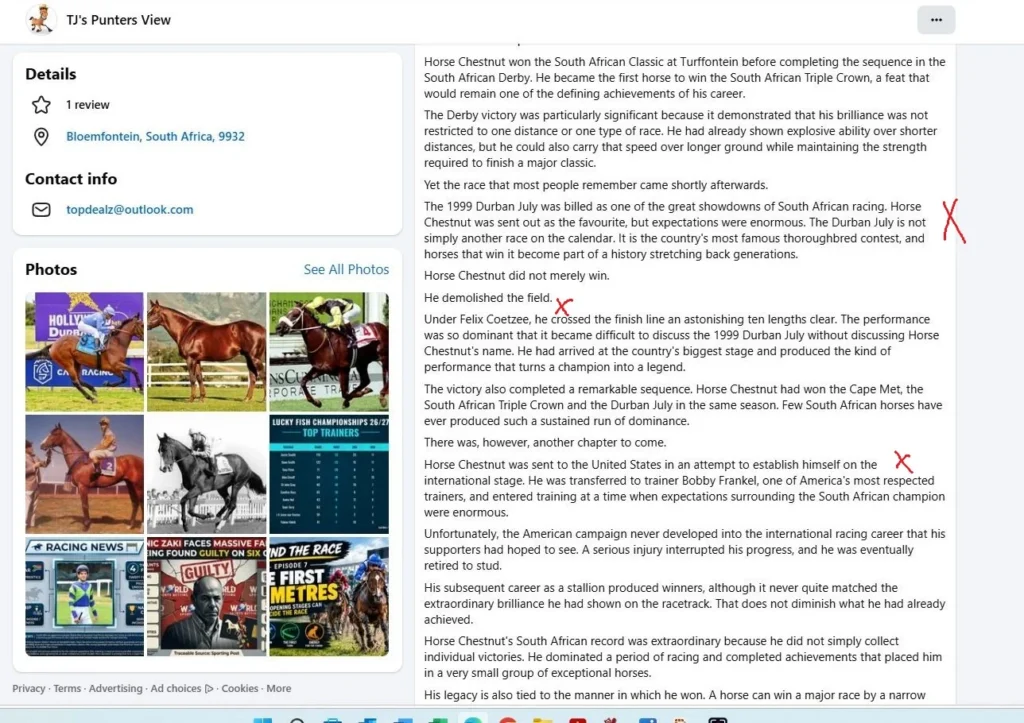
Last week, however, the page’s headline post presented the Horse Chestnut story, complete with borrowed photographs – one of which was not even Horse Chestnut – and a glowing AI-generated article containing a host of glaring errors, including:
– Horse Chestnut ‘demolished’ the 1999 Durban July field. (Horse Chestnut never ran in the race).
– He was ridden by Felix Coetzee. (Felix never swung a leg over Horse Chestnut).
– He was trained in the US by Bobby Frankel. (Frankel never trained Horse Chestnut).
Newly launched, with an attractive and professionally designed website, is thatsracing.co.za, whose stated intention is ‘to provide stories, the people and the thoroughbreds that make racing the greatest sport on earth’ – noble enough.
Initially, the site carried a large explanation on its home page: “As we continue to grow, we’re embracing Artificial Intelligence (AI) as one of the tools that helps us research, organise information and produce better content. AI is our assistant—not our author.”
That disclaimer appears to have been removed recently, perhaps because drawing attention to the use of AI is not necessarily helpful when the resulting stories are presented as editorial work.
However, the fingerprints of unedited AI writing are often easy to spot: short, staccato sentences, repeated ideas, one-line paragraphs and over-amplified conclusions:
It is what it is.
It really is what it is.
We have to accept it and move on.
We shouldn’t pretend that horseracing is the domain of the select few.
It isn’t.
Maybe it was.
But it is no more.
So, let’s get over it. For the sake of posterity, let’s not wait another second to get over ourselves.
Glistian Events, another entity very active on Facebook, noted in a recent post: “We don’t want racing to be some untouchable world where only the ‘experts’ are allowed to have an opinion. Racing belongs to everyone.”
And they are 100% right. Racing is for everyone. But for the sake of accurate history, we sincerely hope that all the new players on the block will set their desire for followers and accolades aside and put fact-checking first.
AI makes mistakes – plenty of them – and its knowledge of historical racing facts is incomplete and often wholly incorrect, particularly when it comes to South African racing history.
Once an error enters the system and is repeated often enough, it can acquire the appearance of fact. When factual errors concern horses, races, people and events that form part of racing’s history, they become a distortion of the record.
The modern media landscape is already awash with misinformation presented as fact, and racing is not immune. It is a free-for-all circus now. Cool. But do we want the next generation of racing fans to believe Horse Chestnut won the Durban July by a record margin? Of course not. If we are going to embrace all the new voices, let’s at least insist on one thing: Stick to the facts – and nothing but the facts.
We asked members of the racing media for their views, and received some interesting perspectives.
Veteran racing editor Andrew Harrison commented: “You can see a piece written by AI a mile off. The language is perfect and loaded with flowery adjectives and hyperbole that has little bearing on what actually happened or might happen.
“One example: When a recently appointed manager at (the old) Gold Circle was tasked to rationalise the publishing department, he said, ‘Look, I have asked AI to write a review of yesterday’s race meeting’.
“I read the piece. It was a lowly midweek affair, but came complete with champions and cheering crowds.
“Whether the general readership gives a rat’s arse about who or what wrote the article is another matter.”
Gary Lemke, who has a long career in sports and racing journalism, agreed with Harrison.
“AI has become the scourge of our times. ChatGPT, for one, makes countless factual mistakes, and those mistakes become recycled fact.
“The style is often staccato and predictable, like ‘It’s not this, it’s this’ or ‘Three tests. Two teams. One winner’. Most ‘professional’ social media is already AI-generated. I saw a social media post recently about a horse winning a maiden at the 20th attempt, and it sounded like it had won the July. ‘Thundering hooves. Majestic strides.’”
Lemke also touched on AI’s impact on photography.
“It’s a generational thing, sure, but photographers were first to get the assistance. AI has taken it to a new level. Change and progress is good, of course. But we’re now in a ‘one size fits all’ world in which virtually anyone can be a writer or photographer. And that’s not good for those who consider writing and photography as an elite skilled profession.”
Award-winning photographer Candiese Lenferna said she uses AI selectively in her work.
“In my photography, I use AI as part of Photoshop and Lightroom for corrections, such as removing grooms from sales images and taking flies off horses’ eyeballs, and that’s as far as it goes. It is really not a question of running a set of photos through AI and getting perfect products back in two seconds.”
She stressed that advanced technology certainly doesn’t make anyone an expert lensperson.
“I can tell you that photos taken on a morning at Summerveld can take a day or more to edit. And, like writers, photographers are not all the same. If all of us were the same, then you could stick your camera on a chair and ask it to do the work!”
Lenferna also uses AI to assist with research for her written work, although she has reservations about its reliability.
“For the written aspects, I use AI to assist me with my research (which is actually a bit of a joke, given what I’m going to say next!) and I find it highly inaccurate. You have to ask it to double-check, and then it usually corrects itself, which is itself a waste of time. But I still have to go and manually check it anyway. Your sample attached (TJ’s Facebook page) is a typical example.
“Ai is just too inconsistent and incorrect a lot of the time when it comes to racehorses, pedigrees and records.”
Michele Wing said that AI lacks the human capacity for intuition, critical judgement and an enquiring perspective. She commented: “In the hands of a knowledgeable and experienced journalist, AI can be a valuable tool that enhances the work. In the hands of someone without the necessary knowledge or understanding, it can be equally reckless.
“The dilemma is not an either-or choice between AI and human journalism. It is about where we draw the boundary between the two.”
Like most, the media divisions of 4Racing and Race Coast are still learning about AI and exploring where it might lead.
Colin Gordon, COO of 4Racing, commented: “There is a place for AI across every aspect of our daily lives now, but the expert in the subject material will still be required and, in an ironic way, will get the most out of AI assistance.”
The Hollywood Group, which includes Sporting Post, already has extensive AI policies in place. Its Brand and Communications Manager, Devin Heffer, said: “AI journos don’t offer that same simpatico that comes from a real person. People are lazy. If they use AI and don’t bother to fact-check, that is where the problem comes in. That is where misinformation is spread.
“AI helps as a tool for assistance with grammar, spell-checking and restricting sentences. But it doesn’t have the same understanding that gives you a comprehensive vision. It also hallucinates. If it doesn’t have an answer, it will give you one to satisfy your request.
“I think eventually AI will evolve to get better. It already increases efficiency in programming and speeds things up in other industries. In racing, we need to look at how we can use it to better the sport – in terms of customer habits and behaviour, marketing strategies and so on.
“Journalists can read a race, get input from stakeholders and supply perspectives that are original and not known to AI. It cannot replace the touch that original journalism brings.”
To conclude this edition of Off The Record, I asked the free version of the popular AI bot ‘Claude’ (sounds like a Maître d’ in a Michelin star restaurant) for two sentences. I received something that more or less repeated my ‘sticking to the facts’ bit from an earlier paragraph.
But I lifted the sentence below, as it seems a suitable ending. Thanks Claude!
The record of racing belongs to the sport, not to the algorithm.
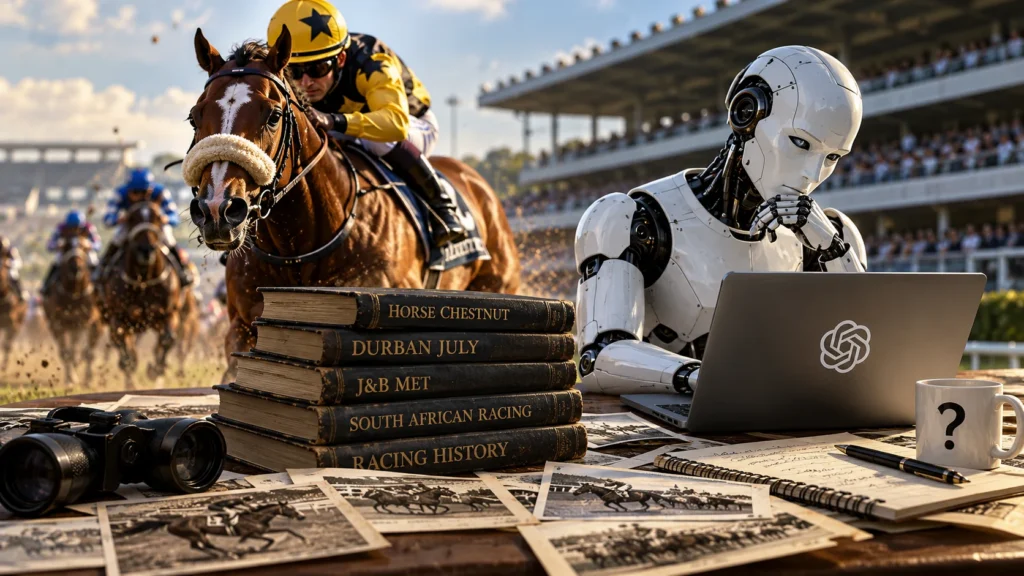
(Headline Image by Grok AI).