
OFF THE RECORD #127
The Forgotten Champion Who Chased July Immortality
One of the pleasures of horse racing is looking back at the champions of earlier generations and wondering how they would compare with today’s stars. It is an impossible debate to settle, but one that never loses its fascination.
Among the great names of the past is Home Guard, a horse whose achievements have almost faded from public memory despite being unique in Hollywoodbets Durban July history. He remains the only runner ever to line up for the great race unbeaten after no fewer than 11 starts, which remains, by available historic accounts, a South African record.
Interestingly, Home Guard’s remarkable story follows an unexpected path and even shares a fascinating, albeit indirect, connection with this year’s Hollywoodbets Durban July contender, Hazy Dazy.
Home Guard was bred and raised by Jim Armitage at Rathvale Stud in the Standerton district, an area at the time renowned for producing tough racers, much like the Karoo region where the Birch Brothers reigned supreme for many decades.
Home Guard was sired by Penthouse II (GB) out of Storm Lily (Davey Gordon), a prolific producer of top thoroughbreds, including Home Guard’s own brothers Storm Glow (12 wins) and Storm Signal (9 wins), and four other stakes winners.
Rathvale Stud leased many of their horses to trainer Henry Eatwell and his wife, ‘Nessie’ and Storm Glow (1964) and Home Guard (1965) were both running advertisements for the stud in 1967 and beyond.
Eatwell trained from the then-booming racing village of Newmarket, Alberton, and was known for sending his horses to the gallops between 4.30am and 5am. He preferred to line them up under the cover of darkness and often booked renowned ‘money’ jockeys Gerald Turner and James Maree to partner his better runners.
For Home Guard’s debut in a Maiden Juvenile Plate over 800m at Gosforth Park on 11 November 1967, however, Eatwell engaged the less fashionable but highly capable Bobby Palm. It may well have been a tactical move to secure better odds in a race where the subsequently brilliant Sky Line, later winner of the Grade 1 Cape Guineas and Cape Derby, was widely regarded as unbeatable.
The ploy worked. Home Guard was backed into 9-4 and proceeded to beat Sky Line by six lengths, hard held.
Johnny McCreedy and Gerald Turner shared the riding honours as Home Guard stretched his unbeaten record with another six consecutive victories at two. Among them were commanding triumphs in the 1968 Grade 1 SA Nursery over 1080m and the East Rand Juvenile Stakes over 1600m, highlighting his rare early combination of speed and stamina. The combined winning margin for his first seven wins was 32,75-lengths.
Turner commented some years later: “In the morning Home Guard was very keen to get his work over with, he wasn’t one to mess about. He was a tough horse who was suited to Mr. Eatwell’s style of training. He was a lovely horse to ride in a race; you place him anywhere and he could win from anywhere.”
Home Guard carried that brilliance into his three-year-old season, with James Maree partnering him to another four consecutive victories. He launched the campaign in sensational fashion in the Grade 2 Transvaal Invitation Champion Stakes over 1600m at Turffontein. Taking on a quality field of older horses, he drew clear in the closing stages to beat the highly regarded six-year-old William Penn by 2.25 lengths.
The victory was especially significant. Just a month earlier, William Penn had finished a close second to Chimboraa in the Durban July, adding considerable substance to Home Guard’s performance. Racing fans took note. While he was already highly regarded, he was now firmly established as one of the country’s rising stars and a major crowd-puller.
Home Guard then reeled off another three consecutive Grade 1 victories. As the unbeaten colt continued to sweep aside quality opposition, racing enthusiasts and the press began speaking of him as the next Hawaii, who, incidentally, had finished fourth behind Chimboraa and William Penn in the 1968 Durban July.
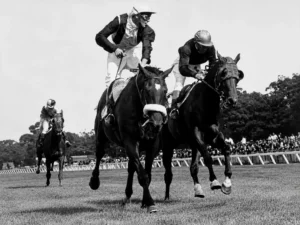
Home Guard followed up with a five-length victory in the Grade 1 Benoni Guineas before stepping up to 2400m for the Grade 1 SA Derby, where he defeated Stalwart by three-quarters of a length.
It was on Derby day, however, that the first warning signs of respiratory problems emerged. After pulling up, Home Guard began making an unusual noise, prompting jockey James Maree to dismount.
“When I pulled him up after the finish, he was making a loud breathing noise, so I got off him and led him on foot to the winner’s enclosure,” Maree recalled.
He was then sent to Cape Town to prepare for the prestigious Grade 1 Cape Guineas, but the journey proved ill-fated. It was there that Home Guard contracted influenza, forcing Eatwell to withdraw him from the race.
Home Guard was given a lengthy spell to recover and, in preparation for his first attempt at the then Rothmans Durban July Handicap, returned with a comfortable 1.75-length victory over Naval Escort in the SA Guineas in early June 1969.
Backed to 2-1 favourite for the ‘July’, to make it 12 wins in a row, Home Guard suffered his first defeat, failing by just 0.75-lengths to his old rival Naval Escort when he had to concede the Guineas runner-up 5,5kg. As good a performance as that was, Eatwell noted that Home Guard’s breathing was starting to trouble him badly.
A ‘Hobday’ operation was performed at the end of Home Guard’s three-year-old career – a surgical procedure to remove the vocal cords and the lateral ventricles of the larynx to eliminate the disruptive vibrations and noise.
Rested, and sparingly raced at four, Home Guard had no success and ended the 1969/70 season finishing five lengths adrift of Court Day in the 1970 Durban July, giving the winner 6kg.
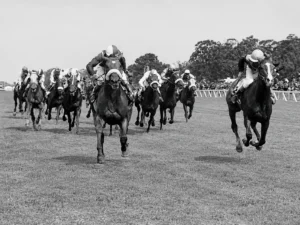
Appropriately enough, Home Guard returned to the winner’s enclosure as a five-year-old under Johnny McCreedy, landing the Grade 1 Johannesburg Summer Handicap over 2000m by a short head from Acheval, ridden by his former partner, James Maree. He followed up with victory in the Grade 1 Hawaii Stakes over 1600m at Turffontein on New Year’s Day, 1971.
Eatwell then prepared the big horse for a third attempt at the Durban July, following a promising pipe-opener in the Chairman’s Cup over 1400m. But it was not to be. Home Guard again failed to capture South Africa’s greatest race, finishing eight lengths behind Mazarin while conceding the winner 9kg.
Home Guard rounded off his career winning the Grade 1 1971 Woolavington Cup at Clairwood, showing a record of 29 runs for 14 wins (seven at Grade 1 level), 6 seconds and 1 third placing.
Eatwell said: “He was simply a terrific horse, but was never quite the same after his operation. Had he not gone in the wind he would have been the greatest horse of all time. As a three-year-old I would work him over 1400m, let him pick up a Merchants winner at the 800m mark and he would thrash the older horse. Nothing would ever have beaten him.”
Racing writer Alan Breck (Alf Copestake) penned in the SA Racehorse 1975: “Relatively, Home Guard was rated 21lbs (10.5kg) better than was Hawaii as a two-year-old, and is the highest juvenile so ranked in the seven years these lists were compiled by official handicappers.”
Home Guard retired to stud at his birthplace, Rathvale, but didn’t receive much support. There are confusing reports online in which Home Guard (SAF) is often confused with Summerhill stud’s top imported stallion Home Guard (USA), by Forli, who sired a champion sprinter, three Derby winners and an Oaks winner.
Rathvale’s Home Guard, the wonderful track star, produced only a single stakes winner in 15 crops – House Warming, winner of the 1979 Grade 3 Lonsdale Stirrup Cup.
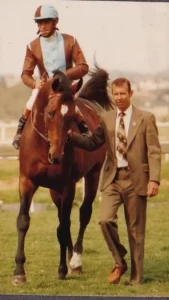
Veteran horseman Tobie Spies worked as the stud manager for Trevor Armitage at Rathvale in the early 1980s and recalled: “Home Guard stood alongside Jawad and Kirsch Flambee. His problem at stud was that he was related to many of the mares at Rathvale, some of whom were also by Penthouse 11, and received little support from other breeders.
“There was a time when I tried to persuade Trevor and the Birch brothers to swap stallions for a season, so Home Guard could go to the Karoo to cover suitable mares while their Sea Cottage came to us, but the idea never came to fruition.”
Spies remembers Home Guard as ‘a very naughty but lovable horse’ that remained especially close to his heart.
“Because of his Hobday operation, he couldn’t neigh like other horses. To everyone’s continual amusement, he made a most peculiar snorting sound whenever he covered a mare.”
In April 1985, the Newmarket Turf Club invited Spies to bring Home Guard back to the racetrack for a parade before his old and appreciative admirers. Several thousand racegoers turned up to welcome the champion.
Then 20 years old, the entire looked magnificent and was once again partnered by James Maree, who donned the Eatwell family’s light blue and brown silks.
“Home Guard was proud and full of himself that day. He loved being back at the track,” Spies recalled. “James kept saying, ‘Hold him, Tobie, hold on tight, don’t let go!’ Eventually we got him onto the track proper and he cantered down beautifully to a tremendous ovation.”
Just a few months later, Home Guard died of suspected colic and was buried on the farm. Spies went on to enjoy a successful training career and saddled one Durban July runner, the talented Yardmaster, who finished fourth to Royal Chalice in 1988.
Corne Spies, who was in his early teens and living with his family in a house at Rathvale Stud when Home Guard was doing stud duties, said: “The interesting thing is that Yardmaster was owned by the late David Makins, one of our first and longest-standing patrons who also bred Hazy Dazy shortly before he passed away.”
More than half a century after Home Guard’s brave but ultimately unsuccessful pursuit of South Africa’s greatest race, the story comes full circle. Corne on Saturday saddles Hazy Dazy in his first Hollywoodbets Durban July, while the memory of the only horse ever to line up unbeaten after 11 starts is all but forgotten.
Sources:
www.aro.co.za
www.southafricanracehorse.wordpress.com
Thanks to Oscar Foulkes, Tobie Spies, Jehan Malherbe, James Maree, Dr Terry Casey