
OFF THE RECORD #124
Ormond Ferraris
A portrait assembled from moments
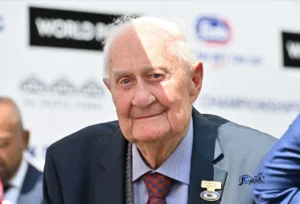
There are some people in racing whom you simply assume will always be there.
For me, Ormond Ferraris was one of them.
As a young boy growing up in the 1970s, I knew Ormond Ferraris’ name long before I knew the man.
My journey as a racing fanatic was probably not that different to that of thousands of others who crossed paths with him over the decades.
They watched him as children.
Then as punters.
Then as owners.
Then as fellow trainers.
Then, as old men looking across the parade ring at another old man.
The racing industry changed. Racecourses disappeared, one after the other. Owners came and went. Jockeys came and went. New generations arrived.
Yet Ormond Ferraris remained.
He was part of my own life and career for the last 50 years, and a rare constant in South African thoroughbred racing for more than 70. In this time, I was fortunate enough to accumulate a collection of memories involving Ormond Ferraris. Some found their way into our book, Thoroughly: Seven Decades in the Sport of Kings and Crooks, while others remained untold. In the days following his passing, a few of them seem worth sharing.
August 1982
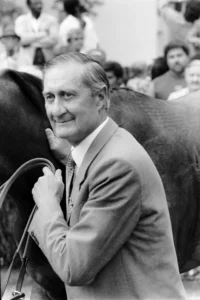
I had an uncle who showed an interest in my racing activities. He took me to Turffontein one day in August 1982, when I was 14 years old. Youngsters under 18 weren’t allowed on the track. But I snuck in, I was allowed through the turnstiles.
My uncle dared me to approach Mr Ferraris and ask him if his sprinter King Of Jazz would win the big race. I followed the trainer from the parade ring to the escalator that led up to the grandstand. I stepped on, just behind him. He was dressed in a grey suit and a hat, with a pair of binoculars over his shoulder. I looked up at this much-admired man and said, ‘Hi sir, can King Of Jazz win?’
Mr Ferraris saw that I was a young guy probably not allowed on the track, seemed bemused and paused a while. He may have frowned. Then he said, ‘He’s fit, boetie. Ta.’ We told everyone who wanted to hear that we had ‘inside info’. We backed King Of Jazz and he won handsomely.
May 1989
When I was 22 and working as a junior racing reporter for Beeld in Johannesburg, I was asked by Dr Hilda Podlas to write a report on their new imported stallion, Formaz (Forli), who stood at Ormond Ferraris’ Rooispruit Stud outside the Karoo town of Middelburg. She asked me to take photos, so I borrowed a fancy camera from the newspaper’s photographic division and was given two rolls of 35mm film and a crash course on how to use it.
I was a member of a group including Podlas and Emmanuel Cambouris, and veterinarian, Dr Tim Roberts. We flew to Bloemfontein and hired a kombi for a four-hour drive to Middelburg, where Ferraris, a few other Karoo breeders and some townsfolk awaited us.
Formaz was taken out of his stable and paraded. I fussed around him with my borrowed camera, trying to look as though I knew what I was doing.
Perhaps I fooled the group of onlookers, but I fooled myself too. Near the end of the parade, the camera stopped working, so I took a few steps away to the shade of the farmhouse and opened the film chamber. The roll of film was not fully completed and stuck – immediately spoilt by the fact that I’d exposed it to light – and I took a walk around the wall to privacy, pulled the whole roll of film out and shoved it into my jacket. I replaced it with the second roll and asked for a few more photos, then frantically took a few new ones, again pretending to be a thorough professional.
When Formaz was returned to his barn, I told Dr Podlas and Mr Cambouris that I got some super snaps for their promotional campaign. This time, there appeared to be nothing stuck in the camera, so I was ready to remove the roll and stow it safely.
However, when I opened the camera’s latch my heart skipped a few beats. I expected it to have automatically rewound the spool for removal. But, sadly, it hadn’t. A piece of film was stuck in the rewinding mechanism and, again, the spool was exposed to light and rendered useless. At that very moment, pale as a ghost and desperately fiddling with the camera, I looked up to find Mr Ferraris standing nearby, frowning at me.
“You f****d it up, didn’t you, Boetie?” he said.
Mr Ferraris knew exactly what had happened. Thankfully, he chose not to share the embarrassing news with Dr Podlas and Mr Cambouris.
That unpleasant duty fell to me the following day, via fax, from the Beeld offices in Johannesburg.
Needless to say, I was never considered again for assignments by the Podlas crew.
November 1989
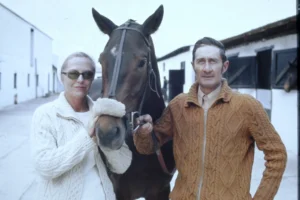
The press brigade of the 1980s was formidable: David Mollett, Robert Garner, Etienne Louw, Francois Wolfaardt, Geoff Sinclair, Andre van der Kooi, Eddie Balshaw, Jeff Zerbst, Chris Oberholzer. Peter Duffield and Graeme Hawkins. There was an unwritten rule: new guys on the block had to prove themselves by interviewing the hard-nosed trainers after their favourites had lost.
Remember, there were no mobile phones, live television interviews or online archives. Every quote had to be obtained the old-fashioned way, with a pen, a notepad and a fair amount of courage.
One afternoon at Newmarket, the Ferraris-trained Fearless Spirit, everyone’s banker, was beaten for the third consecutive time. I was dispatched from the press room to intercept Mr Ferraris for a comment.
When he appeared, I nervously stepped forward and mumbled: “Mr Ferraris? Fearless Spirit, any comment?”
He stopped, gave me a curious look, paused for a moment and replied: “No comment, Boet. Ta.”
Then he walked off.
Back in the press room, I was informed that I was very lucky not to have been sworn at.
May 1992
In May 1992, while standing in for Dave Mollett at Business Day, I was given the opportunity to interview Ormond Ferraris for a newspaper profile.
David Ferraris arranged for me to visit the stable and, as instructed, I arrived at 5am.
For the next four hours I stood alongside the team as the first and second strings completed their morning work. Mr Ferraris barely acknowledged my presence.
At around 9am, I asked David whether we could begin the interview.
Something had come up, I was told. Mr Ferraris could not see me that day.
I would have to return the following morning.
So I did.
Again, I arrived before dawn. Again, I watched the horses work, and there was very little conversation.
Then, shortly after 9am, the day’s work finally complete, Mr Ferraris invited me into his office, poured us both a cup of Rooibos tea and we started talking.
Looking back, I realise the lesson was not intentional, but it was unmistakable. The horses always came first. Everything else came afterwards.
That morning marked the beginning of a friendship that lasted more than three decades and ultimately led to our collaboration on his autobiography, written between 2020 and 2022.
September 2020 – October 2022
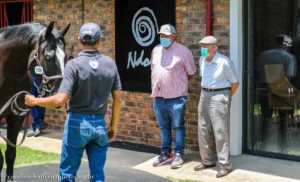
I asked Mr Ferraris to take a few hours jotting down all the relevant issues from his life and career, starting all the way back in the 1930s. I was amazed to get back several hand-written pages with some incredible facts, figures and names from decades ago which were all spot-on when I started checking.
He had an incredible memory at age 90. He said it was not near as good as it used to be, which left me wondering what it was like in his prime. He remembered races and dates, even race times, from as far back as the 1940s, with uncanny clarity, which made my job much easier as I started dotting the I’s and crossing the T’s.
We spent many hours in his Turffontein office – the same old stable office – covering his life story, recorded in sound clips. We went to lunch a few times. He always offered to drive us, in his immaculate C-class Mercedes Benz, to Parreirinha Restaurant in the back streets of Turffontein, an institution for racing people until its closure in 2023.
Mr Ferraris always had half a peri-peri chicken with a fresh breadroll and Coke, and there were three things he spoke about at every lunch – the sad decay of the suburbs in Johannesburg, the disappointing lack of feet at racetracks, and especially the plight of retired trainers. “I have seen too many superb horsemen die without a penny to their name, even some big names. They deserved better.”
He was still very much involved in the Trainers Benevolent Fund he’d started in 1970, and looking for ways to increase its income. He said: “There is enough in the kitty to keep the fund going for several years after I’m gone. I hope someone finds a way to strengthen it and manage it into the future.”
He moved to Plettenberg Bay, but phoned often to say he missed being close to horses and Turffontein.
January 2023 – June 2025
Mr Ferraris moved back into a gated community in Mondeor, south of Johannesburg and started helping his former stable jockey Weichong Marwing, who was developing his own yard at the track. He was chuffed with Weichong’s progress, though lamented the lack of support for the stable at the time.
Mr Ferraris had a collection of every official Jockey Club Calendar published since the late 1890s, and this came in very handy in my own research for various articles, as the NHA’s electronic database only goes back to the early 1990s. He loved helping me with this, and more than once confirmed facts (like the early Derby and Oaks winners) that not even South Africa’s handful of racing historians had access to.
In his final years, he remained remarkably engaged with racing. He delighted in helping me research obscure historical details from his unrivalled collection of Jockey Club Calendars and could often recall facts that had long since disappeared from official databases.
July 2024 – May 2026
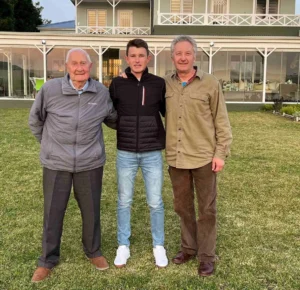
Mr Ferraris was becoming unsteady on his feet, and noted that in a call to me. He finally said good bye to Turffontein and moved into a retirement home in Plettenberg Bay, close to David. He enjoyed watching Luke’s success in Hong Kong and was very happy when Luke jetted in to visit him a few times.
In March 2026, I was doing some research on former star jockey Raymond Rhodes, who rode for Mr Ferraris in the 1970s and was still in good health, but not able to provide me with his riding stats. I asked Mr Ferraris to look up Raymond’s number of wins and Grade 1 successes in his racing catalogues and he checked in every few weeks with a progress report as this assignment required some extra time.
He took a fall in this time and said he was in terrible pain, undergoing physiotherapy and on medication. Then, on 17 May 2026, I received what would be a last call. He’d taken ill again, apologised for not having my information ready and said he’d resume as soon as he strengthened. By then, he’d given me enough to work with.
David Ferraris phoned me again on 20 May, saying that his Dad promised to get back onto the statistics soon, that he was sorry, and that he’d asked for that message to be relayed.
Sadly, the next call from David was last Sunday, 7 June, when I was told that Mr Ferraris was gravely ill and that Luke, Paul and granddaughter Caroline were flying in to be at his bedside.
How do I end this?
Looking back now, what strikes me most is not one of Ormond Ferraris’ great victories, his Hall of Fame induction or even the remarkable longevity of his career.
It is the fact that, in the final weeks of his life, while dealing with pain, illness and increasing frailty, he was still concerned about fulfilling a promise he had made to help me research some needed statistics.
The horses always came first, but the people around him mattered, and his word mattered.
Mine was by no means an exclusive relationship. He influenced hundreds of lives and careers, and he was blessed with a loving family and many loyal friends. Yet in the time I was privileged to spend with him, he gave me his trust, his confidence and his friendship.
For that, and for the unexpected privilege of working alongside a childhood hero, I will always be grateful.
Ta, Mr Ferraris.